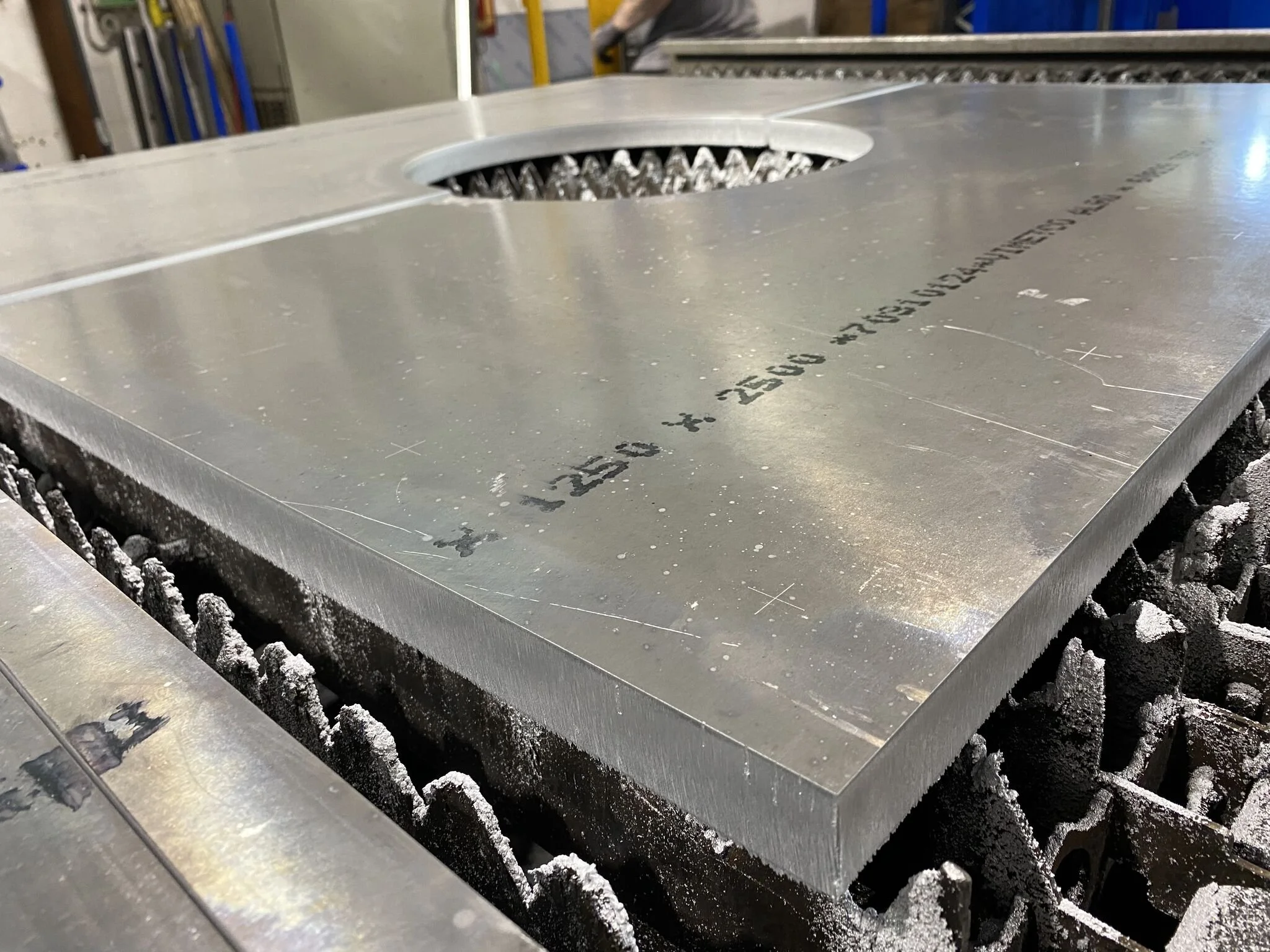
Aluminum, a lightweight and corrosion‑resistant metal, offers excellent malleability and thermal conductivity. It is widely used in aerospace, automotive, construction, and electronics. However, aluminum presents unique challenges for laser cutting: high reflectivity, thermal conductivity that pulls heat away from the cut zone, and a tendency to form spatter and burrs.
ARCUS fiber laser cutting machines are specifically optimized for aluminum alloys. Our systems combine anti‑reflection laser sources, high‑pressure gas assist, and precision motion control to deliver clean, burr‑free edges on aluminum from thin foil to 1″ plate.Contact us today to discuss your aluminum cutting needs or request a free cut test with your material.
Characteristics of Aluminum Laser Cutting
- Corrosion Resistance
Stainless steel’s inherent resistance to corrosion makes it well‑suited for harsh environments. Laser cutting must preserve the passive chromium‑oxide layer.
Application:Nitrogen‑assisted cutting produces a bright, unoxidized edge. No separate passivation needed for most indoor or coastal applications.
Typical parts: Marine rail fittings, outdoor electrical enclosures, chemical storage tank components.
- High Strength
Aluminum dissipates heat rapidly. While beneficial in service, during laser cutting this property pulls heat away from the kerf, making it difficult to initiate and maintain a stable cut.
Application of ARCUS laser cutters: Our “aluminum mode” uses higher power density and faster feed rates to overcome heat loss. Radiator fins, LED heat sinks, and heat exchanger plates are typical parts cut daily on ARCUS machines.
- Good Electrical Conductivity
Aluminum conducts electricity well – which also means it reflects laser light effectively. Reflective surfaces can damage non‑protected laser sources.
Application of ARCUS laser cutters: Full anti‑reflection protection built into the resonator and cutting head eliminates back‑reflection damage. Electrical bus bars, switchgear components, and battery tabs are cut without risk.
- Corrosion Resistance
Aluminum’s natural oxide layer provides good corrosion resistance. However, improper laser cutting can create micro‑cracks where oxidation begins.
Application of ARCUS laser cutters: Nitrogen‑assisted cutting produces a smooth edge without oxidation. The cut edge retains its corrosion resistance for marine, outdoor, and architectural applications such as boat railings, sign frames, and window components.
- Ductility
Aluminum is easily formed, bent, and deep‑drawn after cutting. But a poor‑quality laser edge with burrs or micro‑cracks will fail during subsequent forming operations.
Application of ARCUS laser cutters: Our pulse‑shaping technology produces a burr‑free, crack‑free edge. Bend tests confirm that ARCUS‑cut aluminum can be folded 180° without splitting – essential for automotive body panels, kitchen appliances, and complex enclosures.
- Fatigue Resistance
Aluminum components in aircraft, vehicles, and moving machinery must withstand repeated stress. A rough or notched cut edge acts as a stress riser, shortening fatigue life.
Application of ARCUS laser cutters: Smooth, low‑HAZ edges produced by our controlled cutting process maximize fatigue strength. Aerospace stringers, bicycle frame parts, and drone arms benefit from this capability.
Available Materials
Key Machine Components – Built for Aluminum
Laser Source
IPG, Max, or Raycus (1kW–20kW). Full back‑reflection protection for safe aluminum cutting.
Cutting Head
Precitec or WSX with auto focus and anti‑collision sensor. Sealed optics prevent dust contamination.
Machine Frame
Welded steel, stress‑relieved, 20mm wall thickness. Eliminates vibration for accurate thick stainless cuts.
Controller
CypCut or BodorThink (user selectable). Pre‑loaded stainless library + remote diagnostic port.
Edge Quality & Surface Protection for Aluminum Cutting
In aluminum laser cutting, edge quality and surface preservation are as important as final finishing. The table below shows what you can achieve with ARCUS machines.
| Edge / Surface Type | Process Description | Benefit |
|---|---|---|
| Nitrogen Bright Cut | High‑pressure nitrogen, optimized focus | Oxide‑free, silver edge. Ready for welding or immediate assembly. |
| Oxygen Low‑Dross Cut | Oxygen assist, higher speed | Thin, removable dross. Ideal for parts destined for powder coating. |
| Anodizing‑Ready Edge | Nitrogen + low‑heat parameters | Smooth surface with no embedded oxides – anodizes uniformly. |
| Polishing Equivalent | High‑speed finish pass | Mirror‑like edge, improved aesthetics. |
| Brushed Finish Protection | Low‑pressure follower, cut parallel to grain | No scratches, original #4 or #6 brushed pattern intact. |
| Ductile Edge for Forming | Pulse‑shaping mode | No micro‑cracks – safe for 180° bends. |
Our Aluminum Laser Cutting Process
We use a proven, repeatable workflow for every aluminum cutting demonstration and for your own production after installation.
- 1. Alloy & Thickness Review – You provide the specific aluminum grade (e.g., 5052‑H32) and thickness. We confirm cutability.
- 2. Parameter Selection – Our engineer selects the pre‑qualified profile from the ARCUS library (gas, focus, speed, pierce).
- 3. Piercing & Cutting – Machine pierces with low power to avoid blow‑through, then ramps to full cutting speed.
- 4. Edge & Burr Inspection – Cut samples are checked for edge roughness, dross, and burrs under magnification.
- 5. Optional Post‑Processing – If anodizing or coating is planned, we recommend optimal edge preparation.
- 6. Production Ready – The final parameter set is saved to your machine’s profile. One‑button operation for future runs.
Our Service Commitment
We build our service around one goal: maximizing your uptime.
24/7 North American Support – Real engineers, not robots. Call, email, or remote desktop any time – including nights and weekends.
90‑Minute Response SLA – For production‑stopping issues, we respond within 90 minutes during business hours.
Free Lifetime Process Optimization – New aluminum alloy? We remotely adjust parameters at no extra cost.
US Spare Parts Hub – Nozzles, lenses, protective windows, and motors shipped from our Chicago warehouse same‑day.
3‑Year Limited Warranty – Covers laser source, mechanics, and electronics. Extended plans available.
Free Cut Test Before You Buy – Send your aluminum sample. We cut, inspect, and return. You approve before ordering.
Typical Applications & Industry Cases
Energy
Agriculture
Aerospace
Fitness Equipment Laser Cutting & Welding
Kitchen & Bathroom Laser Welding | Stainless Steel Fabrication
Advanced Laser Processing for Precision Sheet Metal & HVAC
Ready to Cut Aluminum – Clean, Fast, and Without Burrs?
Whether you need a 2kW machine for thin automotive foil or a 10kW system for 1″ structural plate, ARCUS has a solution tailored to your aluminum alloys.
Request a Quote – Tell us your most common grades and thicknesses. We’ll respond with pricing and delivery.
Free Cut Test – Send your material. We cut, inspect, and send back – you judge the quality.
Live Demo – See a 6kW ARCUS cut 5052 and 6061 at our facility or via live stream.
Contact us today to experience the ARCUS difference.
Frequently Asked Questions
A: 0.020″ (0.5mm) reliably. With a specialized honeycomb table, we have cut down to 0.008″ foil.
A: Yes. Our laser sources have full anti‑reflection protection. No mirror damage, no power loss.
A: Simple rule – Nitrogen gives you a ready‑to‑use bright edge (slower, higher gas cost). Oxygen cuts faster (lower cost per part) but leaves a thin oxide layer that must be removed before welding or painting. We provide a gas cost calculator to help you decide.
A: Nitrogen produces a clean, oxide‑free edge – recommended for anodizing or welding. Oxygen cuts faster but leaves a thin oxide that can be removed before painting. We provide a gas cost comparison for each alloy.
A: Nitrogen‑cut edges retain aluminum’s natural oxide layer. We guarantee no edge corrosion for 12 months on indoor applications, backed by salt‑spray testing.
A: 4kW can cut 1″ aluminum at low speed (3‑5 IPM). For production work, 6kW or 8kW is recommended (10‑15 IPM). We provide a thickness‑power chart.