

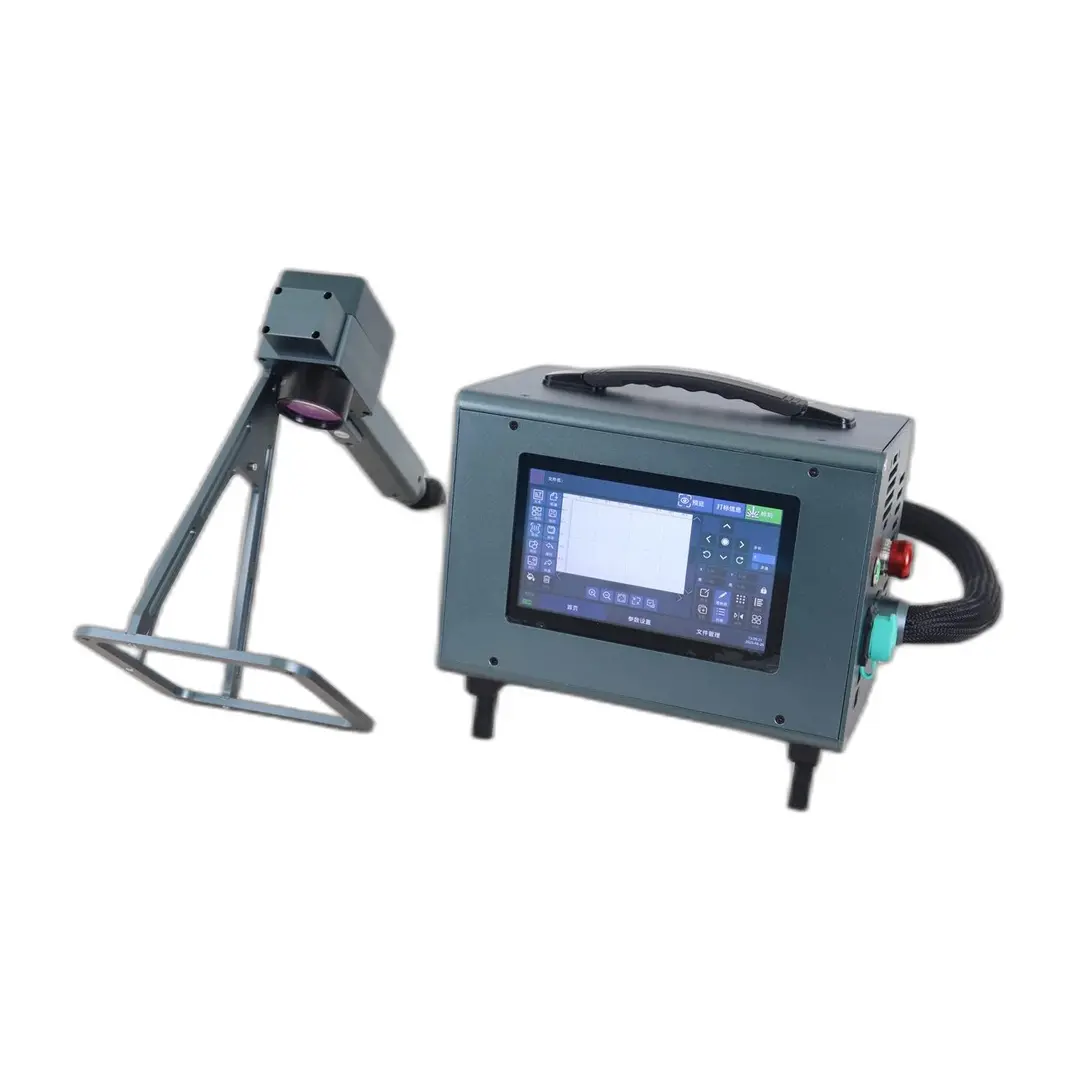
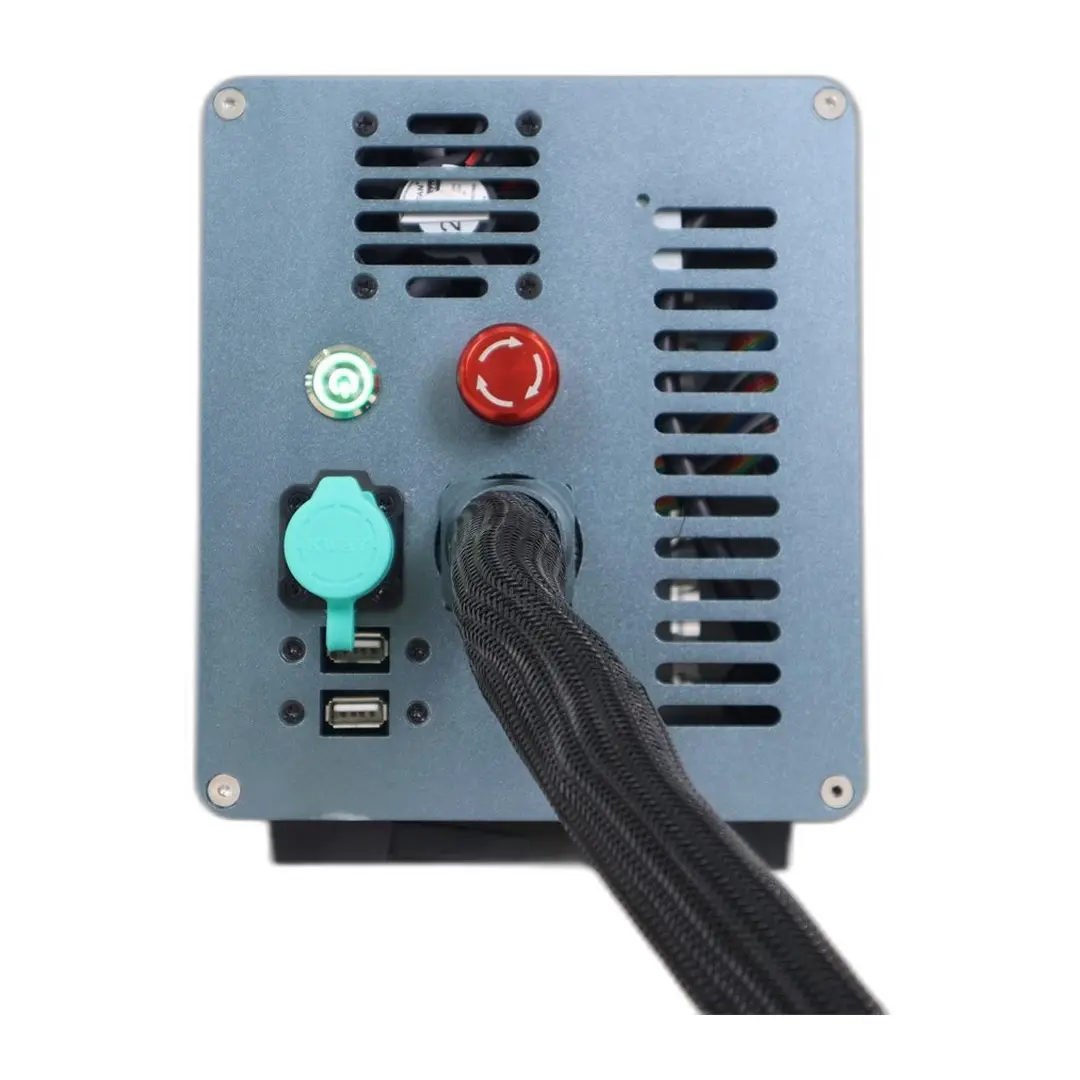
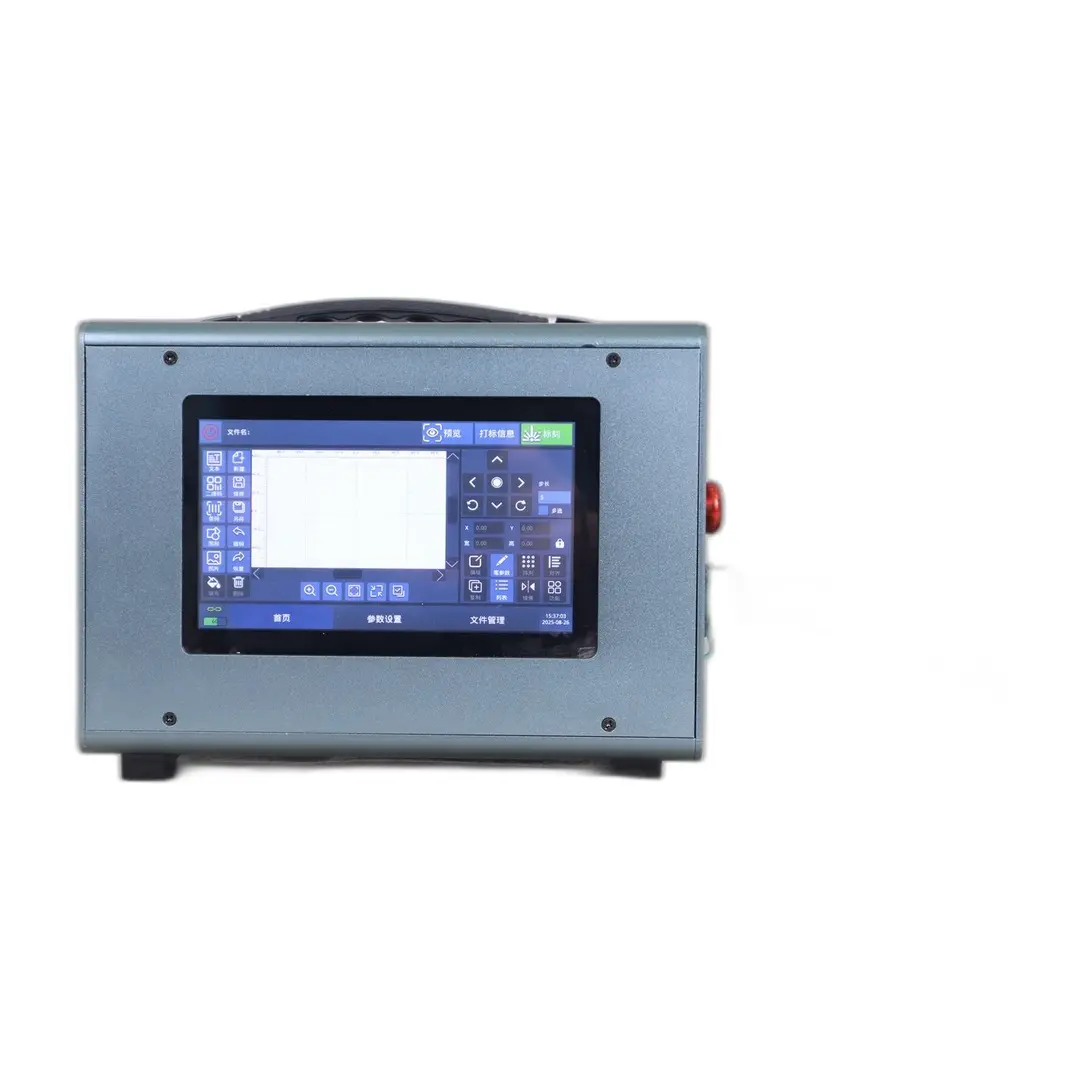
Description
Why Choose a 20W Fiber Laser Marker

Permanent and wear-proof. The marks are fused into the surface rather than printed on top of it. They resist abrasion, solvents, and weather far better than labels, ink, or stickers. For parts that get handled, washed, or used outdoors, that durability matters.
Zero consumables. There is no ribbon, no tag, no chemical, and no ink to buy or refill. Once the machine is on your bench, the running cost per mark is essentially the cost of electricity. Over a year of production, that is a meaningful saving compared with inkjet or thermal-transfer marking.
Air-cooled and plug-and-play. The 20W desktop unit needs no external water chiller. It sits on a workbench, connects to a standard wall outlet, and is ready to run. This keeps your workspace clean, quiet, and simple — ideal for shops, studios, and small factories.
Jewelry-grade precision. With ±0.002 mm repeatability and a 0.01 mm minimum line width, the machine handles fine text, small logos, and detailed artwork on rings, pendants, and charms. You can engrave a name, a date, a fingerprint, or a tiny logo and still read it clearly under magnification.
Fast payback. For small workshops, jewelry designers, gift engravers, and low-to-medium batch production, a 20W fiber marker pays for itself quickly. It is affordable to buy, cheap to run, and versatile enough to take on a wide range of daily jobs.
Key Components and Build Quality
We engineer the AK-F20 around the same core subsystems used in industrial fiber markers, so you get professional reliability without the industrial price tag.
Fiber laser source. The heart of the machine is a 1064 nm fiber laser with a single-mode beam and a lifespan exceeding 100,000 hours. It delivers stable, consistent output with minimal maintenance. Choose Raycus as standard, or upgrade to JPT, Max, or IPG depending on your budget and application.
High-speed galvanometer. The scanning head steers the beam with zero drift, enabling crisp, distortion-free marks at speeds up to 7,000 mm/s. High-speed galvanometers are what let the machine keep up with production batches without sacrificing edge quality.
F-theta field lens. The lens keeps focus uniform and light transmission high across the full marking field, so a mark in the corner is as sharp as a mark in the center. This consistency is what separates a professional result from a hobby one.
Multi-hole aluminum worktable. Screw holes run across the table so you can fit stoppers and fixtures for repeatable batch work. Line up ten identical tags once, and every subsequent piece lands in exactly the same place.
Hand crank and scale plate. A simple crank and measurement scale let you set the focal height quickly for parts of different thicknesses, from a thin metal card to a chunky bracelet.
EzCad2 control software. Running on Windows 7 through 11, the software imports DXF, PLT, AI, BMP, JPG, and PNG files, auto-generates serial numbers and QR or barcodes, and presents a beginner-friendly interface. Most new operators are marking their own parts within an afternoon of training.
Full Technical Specifications
| Parameter | Specification |
| Model | AK-F20 |
| Laser Type | Fiber Laser |
| Wavelength | 1064 nm |
| Output Power | 20W |
| Cooling Method | Air-cooled |
| Marking Area | 110 × 110 mm (175 × 175 / 200 × 200 mm optional) |
| Max. Marking Speed | ≤ 7,000 mm/s |
| Min. Line Width | 0.01 mm |
| Min. Character | 0.1 mm |
| Repeatability | ±0.002 mm |
| Pulse Width | 20 ns |
| Frequency Range | 20–200 kHz |
| Power Range | 0–100% |
| Supported Files | DXF, PLT, AI, BMP, JPG, PNG, TIF |
| Control Software | EzCad2 (Windows) |
| Laser Source Options | Raycus / JPT / Max / IPG |
| Fiber Cable Length | 2 m |
| Power Supply | 110V±10%/60Hz or 220V±10%/50Hz |
| Unit Power | < 0.5 kW |
| Laser Lifespan | ≥ 100,000 hours |
| Machine Weight | ≈ 35 kg |
| Dimensions | 600 × 450 × 750 mm |
What Materials Can It Mark?
Metals are the primary strength of this machine. It handles stainless steel, carbon steel, aluminum, and anodized aluminum with ease. It marks brass, copper, and titanium cleanly. It also works on precious metals — gold, silver, and platinum — which is why it is so popular in jewelry studios. Coated and plated metal parts mark well too, letting you add logos or serials to finished components without damaging the coating.
Some hard plastics can be marked, specifically those containing a laser-additive filler such as certain ABS grades. For transparent, soft, or heat-sensitive plastics, a UV laser marking machine is the better tool. Wood, leather, glass, and acrylic are not suited to fiber lasers — those are the domain of CO2 laser marking machines.
Typical Applications

Jewelry and gifts. Engrave rings, pendants, bracelets, cufflinks, and charms with names, dates, coordinates, fingerprints, or short messages. Personalized jewelry is one of the most common uses for a 20W fiber marker, and the fine detail it produces is difficult to achieve any other way at this price.
Metal nameplates and tags. Produce equipment labels, asset tags, control-panel identifiers, and rating plates with permanent text and barcodes. Because the mark will not peel or fade, it stays legible for the life of the product.
Traceability and serialization. Add serial numbers, QR codes, and barcodes to parts and components for warranty tracking, inventory control, and anti-counterfeiting. Auto-incrementing serial numbers in the software make batch serialization fast and error-free.
Tools and hardware. Mark wrenches, cutlery, small fittings, keychains, and promotional gifts with brand logos or customer text.

Electronics. Surface-mark enclosures and connectors for branding and identification, where light, precise marking is enough and deep engraving is unnecessary.
A Closer Look at Jewelry Engraving
Jewelry is where the 20W fiber laser truly shines. The narrow beam and fine focus let you engrave script as small as 0.1 mm tall and still keep it legible. On gold and silver, the laser produces a clean, contrasting mark that reads as professional engraving rather than etching. On stainless steel and titanium jewelry, it can create both light surface marks and, with repeated passes, a deeper line for bold designs.
For curved rings, the rotary axis keeps the surface at a constant focus distance as it spins, so the engraving stays even all the way around. For anodized aluminum jewelry and tags, consider our MOPA fiber laser if you want black, white, or even color marks — MOPA pulse control gives you far more contrast options than a standard Q-switched source.
Marking Round and Curved Items
Flat surfaces are straightforward, but rings, pens, bottles, and tumblers need 360-degree coverage. For those jobs, add an optional 80 mm rotary axis. The chuck holds the workpiece and rotates it under software control so the laser can mark the full circumference in one setup. This turns a flat-surface marker into a versatile 3D engraver for cylindrical and curved products — no separate machine required.
Which Power Do You Need?
Choose 20W if you mark thin metal, need fine detail, and work at low-to-mid volume. It is the right call for jewelry, nameplates, pens, gifts, and most surface-marking jobs.
Choose 30W if you want a balance of speed and depth for general industrial marking, where you occasionally need a slightly deeper cut and faster throughput.
Choose 50W or higher if you need deep engraving, mold work, or high-volume production where cut depth and cycle time drive your business case.
Optional Configurations
Laser source. Start with Raycus, or upgrade to JPT, Max, or IPG for specific beam-quality or reliability requirements.
Rotary axis. An 80 mm chuck for rings, pens, bottles, and other round workpieces.
Lifting platform or slide. Extended Z-height for bulky or tall parts.
CCD camera. Vision positioning for pre-printed, irregular, or previously marked workpieces, improving accuracy on repeat jobs.
Protective enclosure. An interlocked cabinet for jewelry shops, schools, and training rooms where safety and dust control matter.
Conveyor belt. Inline marking for production lines that feed parts automatically.
Certifications, Warranty, and Support
Certified for export. The machine carries CE, FDA, and ISO 9001 certifications, meeting the requirements of major international markets.
Warranty. We provide a 2-year warranty covering both the machine and the laser source, backed by lifetime technical support.
Training. Every order includes free remote setup and operation training so your team is marking real parts quickly.
Service. Our support team is available 24/7 online, we ship globally, and we keep spare parts in stock to minimize any downtime.
Frequently Asked Questions
What materials can a 20W fiber laser mark?
Primarily metals — stainless steel, aluminum, brass, copper, titanium, and precious metals like gold and silver — plus some additive-containing hard plastics. It is not suited to wood, leather, glass, or acrylic.
Is 20W enough for deep engraving?
No. 20W is designed for surface-level marking such as text, logos, QR codes, and light jewelry engraving. For deep cuts into steel or mold engraving, choose a 50W or 100W fiber laser.
Can it engrave gold and silver jewelry?
Yes. The 20W fiber laser marks gold, silver, and platinum cleanly and is widely used for rings, pendants, and personalized gifts. Use the rotary axis for curved surfaces like ring bands.
Does the machine need a water chiller?
No. Standard 20W desktop units are air-cooled and plug into a normal 110V or 220V outlet, with no external chiller required.
What software does it use?
It runs EzCad2 on Windows 7 through 11 and supports DXF, PLT, AI, BMP, JPG, and PNG files, with built-in serial-number and QR or barcode generation.
Get a Quote
Ready to mark metal and jewelry with clean, permanent results? Request a quote for the Arcus cnc 20W fiber laser marking machine, or talk to our team about rotary axis, enclosure, and power upgrades to match your exact workflow.
Related machines:
- MOPA Fiber Laser for Color Marking
- Fiber Laser with Rotary Axis for Rings & Pens
- Laser Marking Machine Buyer’s Guide

- Laser Cleaning for Rail, Mining, and Heavy Equipment - October 31, 2026
- Laser Cleaning for Marine Corrosion and Ship Maintenance - October 29, 2026
- Laser Cleaning for Food Equipment and Stainless Surfaces - October 25, 2026

Reviews
There are no reviews yet.