
Description
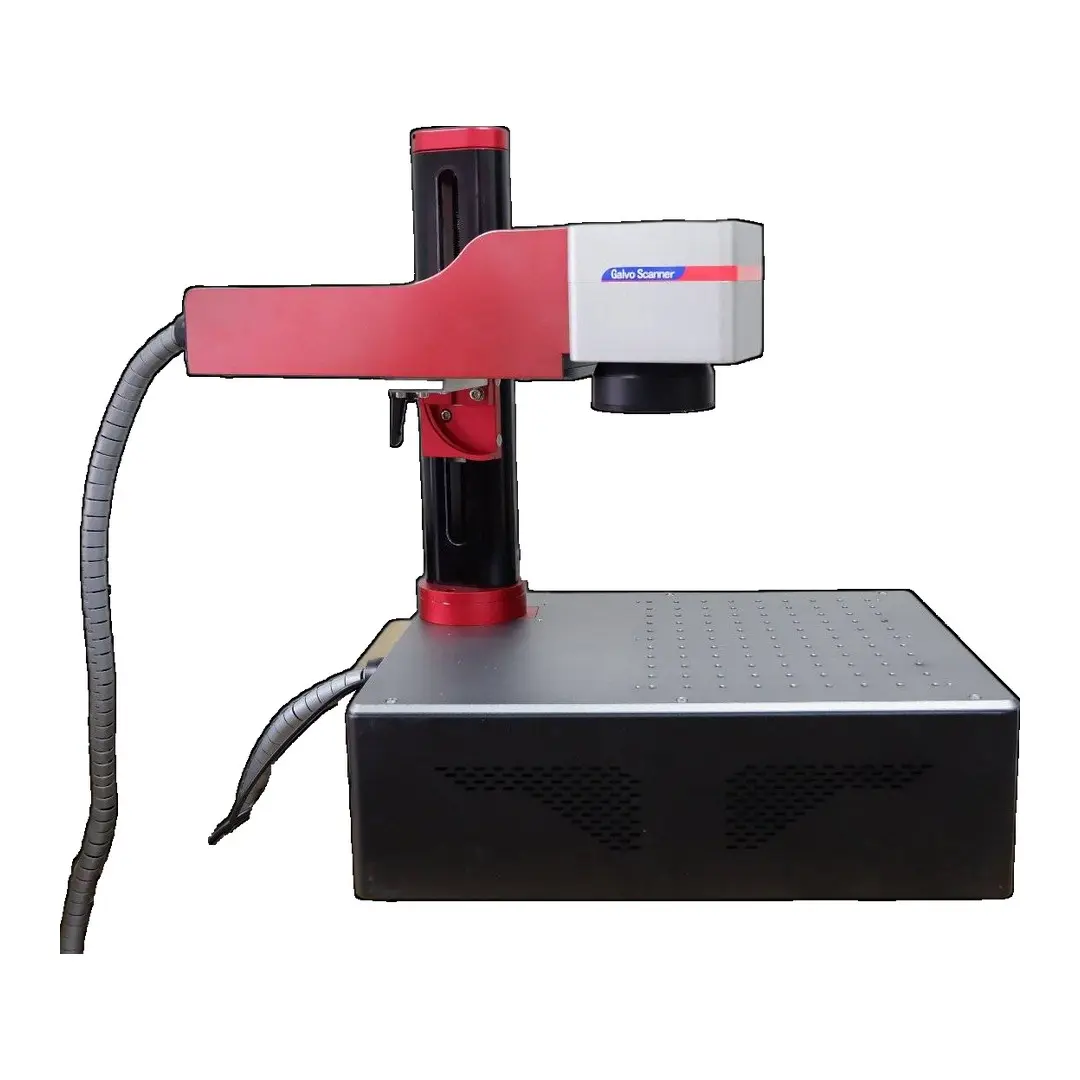
The Arcus cnc 30W fiber laser marker is a compact, air-cooled engraving system built for everyday metal marking on stainless steel, aluminum, and anodized aluminum. It delivers a permanent, high-contrast mark on industrial parts, hardware, tools, and consumer products — without ink, without contact, and without the consumables that drive up the running cost of other marking methods. If you run a job shop, a hardware business, a contract engraving service, or an in-house production line that needs reliable metal identification day after day, this is the power class that balances speed, depth, and price for general-purpose work.
Where a 20W unit is tuned for fine detail and light surface marking, the 30W model adds headroom. It marks faster on the same part, bites deeper when you need a tactile engraving, and holds up better under continuous production. That extra power is exactly what most small factories and engraving businesses find themselves wanting once the first jobs start arriving.

Why Choose a 30W Fiber Laser Marker
Faster throughput on real jobs. The 30W source reaches the same mark in fewer passes than a 20W unit, so a batch of nameplates or tool tags clears the bed quicker. In a production setting, that difference compounds into hours saved every week.
Deeper, more tactile engraving. Need a mark you can feel with a fingernail, or a logo that survives grinding and powder coating? The 30W model cuts deeper — up to roughly 0.5 mm — while still holding fine detail on small text and barcodes. It is the sweet spot for industrial part marking where durability matters more than subtlety.
Permanent and wear-proof. As with every fiber laser, the mark is fused into the surface rather than printed or stuck on top. It resists abrasion, solvents, oils, and weather far better than labels, ink pads, or adhesive tags. For parts that get handled, washed, machined, or used outdoors, that permanence is the whole point.
Zero consumables. There is no ribbon, no chemical, no tag, and no ink to buy or refill. After the initial purchase, the cost per mark is essentially the cost of a little electricity. Over a year of steady output, that is a real advantage over inkjet, dot-peen, or thermal-transfer marking.
Air-cooled and simple to site. The 30W desktop unit needs no external water chiller. It sits on a bench, plugs into a standard wall outlet, and is ready to run — keeping your shop clean, quiet, and free of plumbing and coolant maintenance.
Strong ROI for small business. For workshops, hardware suppliers, promotional-product makers, and low-to-mid volume production, a 30W fiber marker pays for itself quickly. It is affordable to buy, cheap to operate, and versatile enough to absorb a wide range of daily marking requests.
Key Components and Build Quality
We build the AK-F30 around the same core subsystems found in industrial fiber markers, so you get professional reliability without the industrial footprint.
Fiber laser source. The core is a 1064 nm fiber laser with a single-mode beam and a lifespan beyond 100,000 hours. It holds stable, consistent output through long runs with minimal upkeep. Choose Raycus as standard, or step up to JPT, Max, or IPG depending on your budget and application.
High-speed galvanometer. The scanning head steers the beam with zero drift, producing crisp, distortion-free marks at speeds up to 7,000 mm/s. Fast galvanometers are what let the machine keep pace with production batches without softening edge quality.
F-theta field lens. The lens holds focus uniform and light transmission high across the entire marking field, so a mark in the corner reads as sharply as one in the center. That consistency is what separates a professional result from a hobby-grade one.

Multi-hole aluminum worktable. Screw holes run across the table so you can mount stoppers and fixtures for repeatable batch work. Set up ten identical stainless tags once, and every following piece lands in exactly the same place.
Hand crank and scale plate. A simple crank and measurement scale let you set the focal height quickly for parts of different thicknesses, from a thin aluminum sheet to a solid steel block.
EzCad2 control software. Running on Windows 7 through 11, the software imports DXF, PLT, AI, BMP, JPG, and PNG files, auto-generates serial numbers and QR or barcodes, and presents a beginner-friendly interface. Most new operators are marking real parts within an afternoon of training.
Full Technical Specifications
| Parameter | Specification |
| Model | AK-F30 |
| Laser Type | Fiber Laser |
| Wavelength | 1064 nm |
| Output Power | 30W |
| Cooling Method | Air-cooled |
| Marking Area | 110 × 110 mm (175 × 175 / 200 × 200 / 300 × 300 mm optional) |
| Max. Marking Speed | ≤ 7,000 mm/s |
| Marking Depth | ≤ 0.5 mm |
| Min. Line Width | 0.01 mm |
| Min. Character | 0.1 mm |
| Repeatability | ±0.002 mm |
| Pulse Width | 20 ns |
| Frequency Range | 20–200 kHz |
| Power Range | 0–100% |
| Supported Files | DXF, PLT, AI, BMP, JPG, PNG, TIF |
| Control Software | EzCad2 (Windows) |
| Laser Source Options | Raycus / JPT / Max / IPG |
| Fiber Cable Length | 2 m |
| Power Supply | 110V±10%/60Hz or 220V±10%/50Hz |
| Unit Power | < 0.6 kW |
| Laser Lifespan | ≥ 100,000 hours |
| Machine Weight | ≈ 45 kg |
| Dimensions | 620 × 470 × 760 mm |
What Materials Can It Mark?

Metals are the core strength of this machine, and stainless steel plus aluminum are exactly where the 30W class earns its keep. It handles 304 and 316 stainless, carbon and tool steel, and both raw and anodized aluminum with ease. It also marks brass, copper, and titanium cleanly, and works on coated or plated parts without harming the surface finish.
On stainless steel, the laser can produce both a light annealed mark and a darker oxidized mark by adjusting frequency and speed — useful when you want a logo that reads clearly against a brushed or polished background. On aluminum, it delivers crisp black or gray marks on bare metal and precise white or colored marks on anodized layers.
Some hard plastics containing a laser-additive filler, such as certain ABS grades, can be marked too. For transparent, soft, or heat-sensitive plastics, a UV laser marking machine is the better choice. Wood, leather, glass, and acrylic are not suited to fiber lasers — those belong in the CO2 laser marking category.
Typical Applications
Industrial part marking. Add part numbers, batch codes, and logos to machined components, brackets, and enclosures. Because the mark will not peel or fade, it stays legible through assembly, finishing, and field service.
Hardware and tools. Engrave wrenches, cutters, fasteners, measuring tools, and promotional gifts with brand logos or customer text. The deeper 30W bite keeps the mark readable even after heavy use.

Metal nameplates and tags. Produce equipment labels, asset tags, control-panel identifiers, and rating plates with permanent text and barcodes for warranty tracking and inventory control.
Traceability and serialization. Apply serial numbers, QR codes, and barcodes to parts and components for anti-counterfeiting and supply-chain tracking. Auto-incrementing serial numbers in the software make batch serialization fast and error-free.
Aluminum products. Mark anodized aluminum tags, laptop shells, drinkware, and consumer electronics housings where light, precise, high-contrast marking is enough and a clean appearance matters.
A Closer Look at Stainless Steel & Aluminum Marking
Stainless steel and aluminum are the two materials most buyers ask about, and the 30W fiber marker handles both with distinct, predictable results.
On stainless steel, the look of the mark is fully controllable. A high-frequency, low-power setting gives a clean annealed mark that leaves the surface smooth — ideal for surgical instruments, food-grade equipment, and premium branding where you want identification without a rough texture. Dial in more power or slower speed and the same laser produces a dark, oxidized engraving with strong contrast against a polished or brushed finish. That flexibility is why the 30W class is the default for metal product manufacturers.
On aluminum, the result depends on the finish. Bare aluminum takes a crisp gray or dark mark that reads clearly on a bright surface. Anodized aluminum is where fiber lasers shine for color work: the laser removes or discolors the dyed oxide layer to expose the lighter metal beneath, giving you white, black, or even vivid marks depending on the anodizing color. For black-and-white contrast on anodized parts, a MOPA fiber source gives you finer pulse control than a standard Q-switched unit.
For curved stainless tumblers or aluminum bottles, the rotary axis keeps the surface at a constant focus distance as it spins, so the engraving stays even all the way around — no separate machine required.
Marking Round and Curved Items
Flat surfaces are straightforward, but rings, pens, bottles, and tumblers need 360-degree coverage. For those jobs, add an optional 80 mm rotary axis. The chuck holds the workpiece and rotates it under software control so the laser marks the full circumference in one setup. This turns a flat-surface marker into a versatile 3D engraver for cylindrical and curved products, from stainless steel flasks to aluminum cosmetic tubes.
Which Power Do You Need?
Choose 20W if you mark thin metal, need the finest detail, and work at low-to-mid volume — jewelry, nameplates, pens, and most surface-marking jobs.
Choose 30W if you want a balance of speed and depth for general industrial marking, where you occasionally need a deeper cut, faster throughput, and the flexibility to handle both surface and light engraving work. This is the most popular power class for small factories and contract engravers.
Choose 50W or higher if you need deep engraving, mold work, or high-volume production where cut depth and cycle time drive your business case.
Optional Configurations
Laser source. Start with Raycus, or upgrade to JPT, Max, or IPG for specific beam-quality or reliability requirements.
Rotary axis. An 80 mm chuck for rings, pens, bottles, and other round workpieces.
Lifting platform or slide. Extended Z-height for bulky or tall steel and aluminum parts.
CCD camera. Vision positioning for pre-printed, irregular, or previously marked workpieces, improving accuracy on repeat jobs.
Protective enclosure. An interlocked cabinet for shops, schools, and training rooms where safety and dust control matter.
Conveyor belt. Inline marking for production lines that feed parts automatically.
Certifications, Warranty, and Support
Certified for export. The machine carries CE, FDA, and ISO 9001 certifications, meeting the requirements of major international markets.
Warranty. We provide a 2-year warranty covering both the machine and the laser source, backed by lifetime technical support.
Training. Every order includes free remote setup and operation training so your team is marking real parts quickly.
Service. Our support team is available 24/7 online, we ship globally, and we keep spare parts in stock to minimize any downtime.
Frequently Asked Questions
What materials can a 30W fiber laser mark? Primarily metals — stainless steel, aluminum, brass, copper, titanium, and coated or plated parts — plus some additive-containing hard plastics. It is not suited to wood, leather, glass, or acrylic.
Is 30W enough for deep engraving? It handles light-to-moderate deep engraving up to about 0.5 mm on steel, which covers most industrial part marking and tool identification. For deep mold engraving or heavy cutting, a 50W or 100W fiber laser is the better fit.
Can it mark anodized aluminum? Yes. The 30W fiber laser marks anodized aluminum cleanly, producing white, black, or colored marks by removing or discoloring the dyed oxide layer. For maximum black-and-white contrast control, consider our MOPA fiber option.
Does the machine need a water chiller? No. Standard 30W desktop units are air-cooled and plug into a normal 110V or 220V outlet, with no external chiller required.
What software does it use? It runs EzCad2 on Windows 7 through 11 and supports DXF, PLT, AI, BMP, JPG, and PNG files, with built-in serial-number and QR or barcode generation.
Get a Quote
Ready to mark stainless steel and aluminum with fast, permanent, production-grade results? Request a quote for the Arcus cnc 30W fiber laser marker, or talk to our team about rotary axis, enclosure, and power upgrades to match your exact workflow.
Related machines:
- MOPA Fiber Laser for Color Marking
- Fiber Laser with Rotary Axis for Rings & Pens
- Laser Marking Machine Buyer’s Guide

- Laser Cleaning for Rail, Mining, and Heavy Equipment - October 31, 2026
- Laser Cleaning for Marine Corrosion and Ship Maintenance - October 29, 2026
- Laser Cleaning for Food Equipment and Stainless Surfaces - October 25, 2026

Reviews
There are no reviews yet.